


Recommended combination


Product description
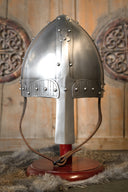
This spangenhelm is the nasal helmet type. Helmets like this saw use across Europe from the 9th century onward, remaining in use at least until shortly after 1066 — around the time they appear on both Norman and Anglo-Saxon warriors in the famous Bayeux Tapestry. Vikings wore these helmets, as did other Germanic peoples. This type of spangenhelm eventually evolved into the well-known nasal helmet.
Unlike later nasal helmets, early spangenhelms were originally made from multiple parts connected by spangen — a cheaper production method introduced during the Late Roman period. The nasal guard protects the entire face while keeping an optimal field of vision. These spangenhelms could also be repaired out in the field during campaigns.
The helmet bowl has a conical shape. Decorative eyebrows sit above the lower spang, reinforcing this vulnerable part of the helmet. Like many originals, this helmet features a detachable nasal guard fixed to the lower and middle spang. The nasal guard extends to the mid-forehead — a technique favored for the extra strength it provided.
Interestingly, medieval manuscripts always show nasal helmets like this paired with a chainmail coif.
Product details
Product details:
Max. head circumference: 61
Material: Carbon steel
Thickness: 1 mm
Inlay: equipped with helmet inlay
Based on a historic original
Shipment weight (grams): 3000


