


Recommended combination
Product description
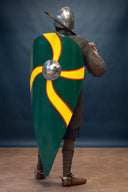
This shield type is based on originals depicted on the Bayeux Tapestry (1066), the Codex Aureus Epternacensis (early 11th century), and the chronicle Liber ad honorem Augusti sive de rebus Siculis (1196). The Normans likely introduced shields like these, and after the First Crusade they saw use across all Christian, Byzantine, and some Islamic armies.
The shield offered excellent protection for both cavalry and infantry. On long marches, soldiers carried them on their backs — sometimes upside down. In the second half of the 12th century, these shields were gradually replaced by versions with a flat top. Early examples like this one often still featured a shield boss, a tradition carried over from the round shield, where the handle mounted behind the boss. On kite shields, the boss no longer served that practical purpose. Instead, it allowed warriors to use the shield offensively in combat — striking with it directly.
This battle-ready Norman kite shield is made from plywood and easy to carry by hand. It stands 134 cm tall and up to 56 cm wide. Weight is about 2.85 kg.
Product details
Product details:
Length: 134 cm
Width: 56 cm;
Material: Plywood;
Thickness: 1 cm;
Based on a historic original: Yes;
Shipping weight (grams): 10000
Shop the look


