


Recommended combination


Product description
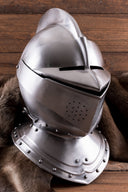
At the end of the 15th century, the close helmet developed from the armet and later versions of the sallet. It strongly resembles the armet and became a symbol of the European aristocracy until the early 17th century. Heavily armored cuirassiers armed with rapiers and wheellock pistols wore it on the battlefield, in formal portraits, and during tournaments. Like the armet, the close helmet fully enclosed the head.
The close helmet looked very similar to the armet, but it opened in a completely different way. Both helmets followed the contours of the head and neck and narrowed at the throat, requiring a mechanism to open and close. An armet opened sideways via two large hinged cheekpieces; a close helmet opened vertically using an integrated rotating bevor, attached at the same pivot points as the visor. Rotating catches fitting into pierced brackets, or spring-loaded pins, locked the moving parts in place. A strap kept the bevor closed.
In the early 16th century, a new armor style developed in England under the Tudors and went on to influence armor across Europe. Henry VIII brought in specialist armorers from France, Italy, and the Holy Roman Empire to work together. The result was the Greenwich style, where armor—sometimes richly decorated—followed the shapes of contemporary clothing. Cuirasses and tassets of the period often imitated fashionable dress.
Full helmets and later burgonets protected the head, sometimes fitted with grotesque visors for parades or festivities. Open helmets like the cabasset and morion also grew very popular. By the 17th century, armor across Europe followed this style.
Close helmets in the Greenwich style feature an upward-pointing visor shaped like a ship's prow. This style was extremely popular among the European aristocracy, and some examples were lavishly decorated. The crest draws on the all'antica style that emerged in Italy in the first half of the 16th century. Renaissance interest in classical antiquity shaped the development of plate armor, and the steel crest stylized the helmet crests of Roman legionaries—letting the wearer connect with that glorious past.
This helmet works great for light combat re-enactment. It features a blackened interior with padding and an adjustable chin strap. Covering both head and neck, it offers solid protection—perfect for 16th-century costumes and reenactment.
Product details
Material: 1.6 mm steel, leather inlay, leather chin strap with brass buckle
Suitable for a head circumference up to approx. 67 cm
Suitable for neck circumference up to approx. 44 cm
Long distance (from back to front): approx. 23 cm
Distance (ear to ear): approx. 20 cm
Height (incl. gorget plates): approx. 37 cm
Weight: approx. 4 kg
Based on a historic original
Shipment weight (grams): 2000


