


Recommended combination


Product description
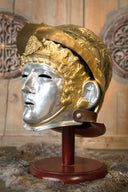
The original of this replica was found in Ribchester, England, and is now on display at the British Museum in London.
In the Roman army, certain soldiers wore larva masks combined with helmets. Although depictions of Roman soldiers with masks are rare, they are believed to have been primarily worn by cavalry officers and standard-bearers, such as the Signifer, Vexillarius, Imaginifer, and Aquilifer. While larva masks may have offered some protection in combat, combat protection was likely not their primary purpose. Often modeled after legendary heroes from antiquity — such as Alexander the Great — the masks reflected a tradition in which individual heroic deeds were glorified and heroes were even deified. Made from iron or brass and frequently silvered, these masks transformed the wearer into an unrecognizable embodiment of a hero, god, or mythical warrior.
This brass helmet depicts a battle between cavalry and infantry. A leather strap attaches the detachable headpiece to the helmet. This helmet is for display only and is not made to be worn.
Horses played a significant role in all Indo-European cultures. More than 5,000 years ago on the Pontic-Caspian steppe, the Indo-European steppe herders — our ancestors — domesticated the horse. From this emerged a cavalry culture: the horse became a key means of transport, a tool in warfare, and an aid in agriculture. It is no surprise, then, that horses entered the spiritual world of our ancestors early on. They believed a horse drew the sun across the sky, and they associated the animal with fertility — of both people and the land. The horse also symbolized kingship and the bond between the ruling aristocracy and the territory they governed.
Product details
Product details:
Length (front to back): 21 cm
Width (ear to ear): 19.5 cm
Max. head circumference: 60 cm
Material: Brass
Thickness: 1.3 mm
Inlay: Helmet cap
Weight: 2.7 kg
Based on a historic original: Yes
Shipping weight (grams): 3000


