


Recommended combination


Product description
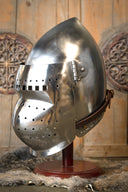
Between 1330 and 1350, bascinets with a flat visor attached on both sides of the helmet began to appear. This was likely a development of the hinged visor bascinet. This type of bascinet is depicted on tomb monuments and other visual or sculptural sources from the 1340s. One of the earliest examples appears on the tomb monument of Sir Hugh Hastings († 1347) in St. Mary's Church in Elsing, Norfolk, England. As with the originals, the visor hinges are fitted with a steel pin, making the entire visor removable. Hinge systems like this were probably an Italian innovation.
This bascinet draws on several originals, including a painting by Spinello Aretino from 1407–1408, the fresco in the Affresco Camera Pinta in Spoleto, Italy, and the manuscript La prima deca by Tito Livio, dated around 1373, now held in the Biblioteca Ambrosiana in Milan. The lower edge features vervelles for attaching a mail collar.
The maximum internal circumference is 68 cm, excluding the helmet liner. The helmet ships with a liner and chin strap. If you want to wear additional padded padding, measure your head circumference while wearing it. The padded cap already attached inside is usually sufficient. To create more space, remove the liner.
Product details
Product details:
Head circumference: 58-63 cm
Material: steel
Steel thickness: 2 mm
Based on a historic original
Shipment weight (grams): 3000


