


Recommended combination


Product description
The so-called bollock dagger, also known as ballock dagger or kidney dagger, owes its quite peculiar name to the two distinctive spherical / egg-shaped protrusions or bulges that form the guard and lend the hilt an explicitly phallic appearance. This particular type of medieval dagger was in use all over Europe and appeared in a myriad of variations over the course of its unusually long lifespan, which lasted from the late Middle Ages (14th c.) throughout the Renaissance. On the British Isles, it even survived until as late as the 17th / 18th c. in modified forms (dudgeon dagger in England and dirk in Scotland).Usually carried as a companion sidearm to a sword or rapier, this thrusting weapon enjoyed great popularity with knights. Its sharply tapered blade with pointed tip was ideal for piercing padded armor and chain mail, or stabbing the opponent through the joints of his plate armor in close-quarters combat. Beyond being a lethal implement, it also served as a fashionable display of wealth — knights and well-to-do townsmen often ostentatiously carried their artfully crafted and richly ornamented daggers as a status symbol.
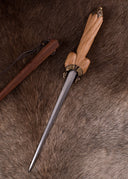
This stylish reconstruction of a 16th century German dagger features an EN45 spring steel blade with a diamond cross-section that tapers evenly to an acute point. The cutting edges are not sharpened, and the tang is screwed to the pommel. The handle with its characteristic lobed guard is carved from a single piece of wood and reinforced with antiqued brass fittings — a butt cap adorned with crosses and an equally ornate, downturned guard plate with ram's head finials.
The dagger comes complete with a vegetable-tanned, neatly stitched leather sheath equipped with a leather cord for attachment to a belt. The cross and ram's head symbols adorning the butt cap and guard plate are repeated on the handsome antiqued brass chape. Designed as a collector's or decoration/display piece, it also works perfectly as a prop — for example, to complete your costume.
Product details
Product details:
Material: EN45 spring steel blade (high-carbon steel, not stainless), aged brass pommel and crossguard, wooden grip
Total length: approx. 36.5 cm
Blade length: approx. 22.2 cm
Blade thickness: approx. 5 mm / 3.5 mm (cutting edges approx. 0.6 mm)
Grip length: approx. 14.3 cm / 16.5 cm with ends (grip approx. 9 cm)
Max. blade width: approx. 1.4 cm
Balance point: approx. -1.5 cm (on the grip, at guard level)
Includes genuine leather scabbard with aged brass fittings and leather cord
Weight without scabbard: approx. 200 g
Weight with scabbard: approx. 260 g
Based on a historic original
Shipment weight (grams): 500


