


Recommended combination


Product description
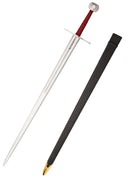
This imposing hand-and-a-half sword, also known as a longsword, dates back to the late 14th century. While the exact origin of this European weapon is uncertain, markings suggest it may be German or Italian. It eventually made its way to the Arsenal of Alexandria, possibly as a diplomatic gift, war prize, or tribute from the Kingdom of Cyprus to the Sultanate of Egypt, where Arabic inscriptions were added. After passing through at least one private collection, the Royal Armouries acquired it.The sword features a broad, powerful Oakeshott Type XVI blade measuring 96.5 cm in length. Despite its considerable weight for the period, the distal taper, long grip, and large pommel keep it well-balanced. Swords of this design appear frequently in late 14th and early 15th-century art, including knightly effigies, manuscripts, and brasses. These versatile swords were popular across Europe—from England to Italy and Portugal to Poland—and featured in contemporary combat treatises such as Fior di Battaglia by Fiore dei Liberi (1410). They were effective in a wide range of contexts: on foot or horseback, in armor or unarmored, wielded with one or both hands. This particular type excelled at powerful cutting but was less specialized for thrusting compared to other longswords of the period.
This replica faithfully reproduces the original in design, dimensions, and craftsmanship. The sheath has a wooden core covered in leather, with a brass chape featuring intricate cut-outs and an acorn-shaped tip. The leather extends to the throat, partially covering the guard at the ricasso for added detail. Manufactured by Windlass Steelcrafts, the original sword is part of the Royal Armouries Collection (Object Number IX.915). Each replica comes with a certificate of authenticity printed on heavy stock.
Product details
Product details:
Hardness: 48-52 HRC
Total length: 123.2 cm
Blade length: 96.5 cm
Blade width at the ricasso: 5.4 cm
Distal taper of the blade: 0.16 cm
Weight: 1700 g
Material: 1065 carbon steel
Edge: semi-sharp
Balance point: 9.2 cm from the crossguard
Based on a historic original
Shipment weight (grams): 2000


