


Recommended combination


Product description
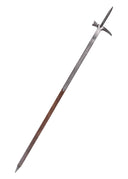
The bec de corbin (French: bec de corbeau, “raven's beak”) is a poleaxe from the 15th–16th century, related to the war hammer. It weapon resembles the Lucerne hammer and consists of a hammer head with a point on a long handle. Unlike the Lucerne hammer, mainly the “beak” or hook was used, not the hammer blade. The balance surface was often blunt, while the Lucerne had multiple points. The beak was sturdier and better suited to penetrating plate armor, chain mail or armor chinks. Some variants did have a multi-pointed hammer. The point on top was shorter and thicker than the Lucerne hammer.
The term bec de corbin sometimes also indicates others war hammers such as clubs (mauls) and horsemen's pikes. The related bec de faucon (“falcon beak”) refers to a poleaxe or specifically to the hook on the back thereof; It was the favorite weapon of armed warriors who fought on foot, and remained popular until the 16th century. Fighting books such as Le Jeu de la Hache (ca. 1400) and Hans Talhoffer's Fechtbuch (1467) deals with the long hammer and poleaxe as an important knightly weapons for fighting on foot.
This one poleaxe is a replica of several originals used during the English War of the Roses. The poleaxe it was weapon ideal for drilling through plate armor. As a result, it was used intensively during hand-to-hand combat. This one poleaxe has several points and is provided with a butt cap.
Product details
Product details:
Material: 9260 carbon steel hardness 50 HRC., wood
Total length: 135 cm
Blade: 15 cm
Point: 9 cm
Semi-sharp 0.5 mm
Weight: 1.4 kg
Based on Historical original
Shipment weight: 8 kg<


