


Recommended combination


Product description
Originally created around the 3rd century B.C. to serve as personal bodyguards of the generals of the Roman Republic, the Praetorians were deployed in camp or in battle and served as a last reserve against attacks on commanders during campaigns. During the Roman Empire, this carefully selected elite unit offered protection to the emperor. As the only armed soldiers allowed within the walls of Rome, they also received higher pay and shorter service terms than standard legionaries. The Praetorian Guard was eventually dissolved in the 4th century A.D. by Emperor Constantine the Size. These greaves are based on originals depicted on sculptures, worn by the Praetorian Guard.
From the first half of the 16th century onwards, the subarmalis and other classical armor pieces came back into fashion. During the Renaissance, classical antiquity received special attention, which led to a new development in plate armor: the al antiqua style. This style is characteristic of the cinqueda, barbute and armor with decorative curves. On frescoes and paintings from this period, Italian knights can be seen wearing classical leg protection, subarmalis and chest armor.
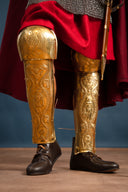
These articulated, fully wearable Roman greaves are made from approximately 1 mm thick brass and blackened on the inside. The shin and knee protectors are connected with hinges for sufficient freedom of movement. They are finished on the sides with three brass eyelets and come with square, 3 mm thick leather cords for proper lacing and adjustments for a perfect fit.
These magnificent Roman greaves are carefully engraved: while one depicts a guard and snakes, the other is adorned with the likeness of Hercules, also surrounded by snakes. Both knee protectors show the Roman eagle.
Product details
Product details:
Material: approx. 1 mm thick brass, leather cords
Total length: approx. 59 cm (40 cm without knee protectors)
Width of the opening at the calf: approx. 13 cm
Width of the opening at the ankle: approx. 9 cm
Dimensions of knee protectors: approx. 17 x 16.5 cm
Weight (pair): approx. 2.44 kg
Based on a historic original
Shipment weight (grams): 3000


