


| Size | Chest circumference | Waist circumference | Hip circumference |
|---|---|---|---|
| XS | 82-86 | 66-70 | 88-92 |
| S | 86-90 | 70-74 | 92-96 |
| M | 90-96 | 74-78 | 96-102 |
| L | 96-102 | 78-85 | 102-108 |
| XL | 102-112 | 85-94 | 108-116 |
| XXL | 112-122 | 94-104 | 116-124 |
| XXXL | 118-126 | 104-114 | 124-321 |
Product description
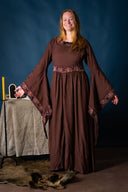
The bliaut (or bliaud) was an outer garment worn in Western Europe from the 11th to the 13th century, especially in areas under French influence. Both men and women wore this garment. The female bliaut is mainly recognizable by the tight-fitting upper body, the spacious skirt and the striking sleeves: tight from the shoulder to about the elbow and then widely flared, sometimes almost to the floor.
From the 12th century onwards, the bliaut was often worn at noble courts. Later variations, known as the bliaut girone, consisted of a fitted bodice and a pleated one skirt, often combined with a belt around the waist. Images of bliauts can be found in medieval sculptures, illuminated manuscripts and the Bayeux Tapestry.
This medieval dress is inspired by historical paintings. The dress has trumpet sleeves which was an absolute status of wealth. This one dress is made of viscose. It is trimmed with polyester embroidery.
Please note: in the photoss and outside the dress redder than inside. Indoors, the fabric shade is brown-red and appears darker.
Product details
Product details:
Fabric: 100% viscose
Fabric embroideries: 100% polyester
Sizes: XS-XXXL
Colour: burgundy
Washing instructions: hand wash
Shipment weight (g): 1000


