


Recommended combination


Product description
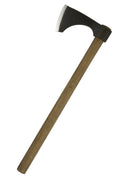
This type of axehead is classified as Petersen type C. The blad has an extremely pronounced beard, with a broad flared section behind the eye, and is one of the most striking forms of bearded axes. This type is a further development of bearded axes that have been used since the Late Roman period. Most specimens have been found in Sweden, a few in Norway, but no specimens have been found in the United Kingdom. This type of axe was probably used as a battle axe, because the connection to the handle is relatively thin for a woodcutting axe. Axes of this type may have been originally developed by Slavic peoples from the Baltic region.
The "beard" – the downward-extending part of the blad – provided a larger cutting surface without making the axe heavier. Thanks to this design, the user could hold the handle just behind the head to carve or work wood. In combat, the beard also had advantages: with it, for example, one could knock off or pull towards oneself a shield or weapon of an opponent.
This bearded axe has a blad made of carbon steel with a hardness of 52 HRC. It is semi sharp. This axehead is finished with an antique coating, making it look lifelike. The handle is made of hardwood.
This Viking axe is 64.8 cm long, has a blad of up to 9.5 cm long and weighs 1077 grams.
Product details
Product details:
Length: 64.8 cm
Size blade: 9.5 cm;
Weight: 1077 g
Material: 65Mn high carbon steel
Edge: Sharp
Including shaft: Yes
Based on a historic original: Yes
Shipping weight (grams): 3000


