


Recommended combination


Product description
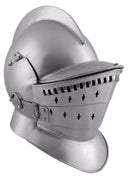
The burgonet helmet (sometimes also called a Burgundian sallet) was a combat helmet from the Renaissance. It was developed from the sallet in the early 16th century and became highly popular throughout Europe. Burgonets were worn by the aristocracy, demi-lancers, cavalrymen, and cuirassiers. In the Anglo-Scottish border region, the Elizabethan Border Reivers were known for their fondness for this type of helmet.
The shape of this helmet was indirectly influenced by the all’antica style (which emerged in the first half of the 16th century) and by the Greenwich style. The crest on this helmet reflects the all’antica influence. During the Renaissance, there was a renewed fascination with classical antiquity, which also influenced the development of plate armor. The steel crest is based on the stylized crests of Roman legionary helmets, allowing the wearer to associate themselves with this glorious past.
From the late 15th to early 16th century, a new type of bevor appeared. This bevor consisted of several lames with an integrated visor and was also known as the “falling buffe” because the visor could be completely lowered. When the bevor is lowered, it offers an optimal field of vision; when raised, it forms an almost fully enclosed visor, similar to that of a closed sallet. This type of bevor was most commonly used together with later kettle hats, sallets, or burgonets.
This burgonet is based on 16th-century originals. This type of helmet remained in use well into the 17th century. It provided excellent protection while maintaining a good field of vision, offering significant advantages over its predecessors. This burgonet features a neck guard.
The burgonet can be worn in three different ways, depending on the desired level of protection or visibility:
-
As a standalone burgonet (optionally with neck guard);
-
With a grill visor;
-
With a fully closed visor.
This burgonet is made of 2 mm thick steel and fitted with a leather liner and chin strap.
Product details
Product details:
Material: Steel 2 mm thick
Measurement between ears: 18 cm
Measurement from forehead to back of head: 21.5 cm
Head circumference: 61 cm
Weight: 3600 grams
Based on historical original
Shipment weight: 4.5 kg


