


Product description
The gladius was the most important weapon of Roman legionaries from the 3rd century BC. until approx. the 3rd century AD. Gladii have been found all over the former Roman Empire, subdivided into types, these types are named after the region where most of the types are found. The weapon was designed for stabbing and slashing in close combat. The successor to the gladius was the spatha, a longer type of sword.
This gladius is not a replica of a certain original, but has characteristics of different gladii from the first century AD. of the Fulham or Fulham-Mainz type with a long straight blade and long sharply pointed tip. The scabbard, however, is based on a historical original, namely on remains of a scabbard found in the shipwreck of Porto Novo from the 1st century AD, near Porto Vecchio in Corsica. The scabbard is also characterized as a Fulham-Mainz transition type due to its shape and size.
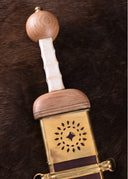
This gladius has a blade made of EN45 spring steel. It has a full tang with a screwed pommel. The hilt is made of bone and wood and the gladius comes with a brown leather scabbard with extensive decorative replica brass fittings. The scabbard also has brass rings for fastening the gladius to a belt.


