


Recommended combination


Product description
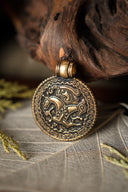
Discovered in 1852 near Køge on the southeastern coast of the Danish island of Zealand, the gold bracteate was found alongside an identical piece. It dates to the Iron Age, specifically between 450 and 570 AD. The bracteate's most distinctive feature is a figure on horseback at the center, believed to represent the Norse god Odin (or Wotan) riding his horse, Sleipnir.The original bracteate carries a surrounding row of runes. Scholars read these as either "Hariuha is my name, the traveler. I give protection on the journey" or "I am called Hariuha. Knowing misfortune, I bring good fortune." Hariuha is likely another name for Odin — in Germanic mythology he adopts various epithets while traveling among people to avoid immediate recognition.
The bracteate is now on display at the Danish National Museum in Copenhagen. The term "bracteate" comes from the Latin "bractea," meaning a thin disc. Germanic bracteates were modeled after Roman imperial medals but struck on one side only. These amulets likely served the Germanic tribes as symbols of luck and may have been awarded to deserving warriors.
Product details
Product details:
Material: bronze
Dimensions: 3 x 3.5 cm
Based on a historic original
Shipment weight (grams): 100


